TONIA KO | Object-based composition as heirloom, memory, and heredity: “Ink and Blood” from ‘Year of the Orchid’
Tonia Ko writes about the process of composing the central movement of her song cycle Year of the Orchid, “Ink and Blood”, which premiered at Brooklyn Art Song Society in 2025.
Introduction
Year of the Orchid by Tonia Ko
Commissioned by Brooklyn Art Song Society
Kristin Gornstein, mezzo-soprano
& Jeremy Chan, piano
The use of both ‘found objects’ and ‘sound objects’ is prevalent in recent compositions, particularly in instrumental genres. The former, a practice of incorporating everyday objects into the instrumentation, is deployed to extend the material vocabulary of a work, while the latter stretches syntactical possibilities of musical seed material beyond traditional motivic development. This article discusses the application of these compositional ‘objects’ in my song cycle Year of the Orchid (2025), specifically in the central movement entitled “Ink and Blood.”
1
Year of the Orchid was commissioned by Brooklyn Art Song Society. The world premiere was given by mezzo-soprano Kirstin Gornstein and pianist Jeremy Chan at the New Voices Festival: Lost/Found III on June 1, 2025, at Roulette Intermedium.
2
The cycle is in five movements, featuring poetry by London-based multidisciplinary writer Jenny Lau. It tells of one year symbolized by an imaginary thirteenth creature of the Chinese zodiac. Rather than one of the twelve traditional animals such as the Ox, Dragon, Dog, or Rooster, this member of the zodiac is a distinctive and ‘exotic’ plant — an orchid.
In the summer of 2024, Jenny Lau saw herself in a small air orchid, unbound to the soil. Although not belonging to any physical place, she identified with the feeling of freedom and choice in the plant’s peculiar state of being. As she writes in “Transnational Orchid”:
Like you, transnational orchid,
I am
culturally uprouted, aerially rooted,
drinking life from all around.
I wouldn’t graft if you even forced me.
Community is my terroir.
3
This dichotomy of freedom and unbelonging relates to my own background, as a composer born in Hong Kong, raised in Hawai‘i, and now living in London after years of study and travel in the continental United States. For the diasporic community with which I identify, there is an in-betweenness to many aspects of our lives. We exist not only between geographic locations, but also between languages, philosophies, and values. While this creates misunderstandings as well as more serious struggles, we also possess the best qualities of this archetypal orchid: resourceful, versatile, fascinating, and complex. These are the qualities I imagined for the narrator of Year of the Orchid.
I discovered Lau’s work through various personal connections in London, aware of her work as ESEA (East and Southeast Asian) community organizer before coming upon her writing. Her social media posts as Celestial Peach, written about our shared Chinese heritage and diasporic identity, resonated strongly with me. In the effort to join up my own internationally scattered connections, I reached out for a collaboration.
The texts for Year of the Orchid are selections from Late spring-summer 2024 poetry: A mini anthology on Lau’s blog.4 The titular year is represented by the outer four movements, settings of haiku poems that reference each of the four seasons: summer, autumn, winter, and spring, respectively. These are conveyed by a narrator who embodies the tone of a Confucian sage who might quote ancient proverbs in passing. The central third movement, “Ink and Blood,” ruptures this metaphorical year, wrenching listeners away from the timeless abstract and into the harsh realities of the here and now. While the four haiku are careful, sensitive observations of ordinary details, “Ink and Blood” is a behemoth of raw emotion, a reflection on the author’s grief after the death of her father.
Structural Goals of “Ink and Blood”
Due to its highly personal nature, a setting of this poem needed to be taken with a balance of care and boldness. Care, to ensure that the narrator’s voice and text’s meaning come across clearly to the audience; and boldness, so that the movement stands out in sharp relief from the rest of the work. Intrinsically, the poem “Ink and Blood” is much longer than its 17-syllable haiku companions; the resultant musical setting similarly confirms its temporal dominance in the cycle.
While most of the shorter movements in the work blur textual semantics through extended vocal techniques,5 “Ink and Blood” utilizes the voice in more traditional ways. This was a purposeful decision, taken to maximize comprehensibility of the text without resorting to spoken passages. The consistency of vocal timbre throughout the movement also allows other compositional features to be more easily perceived by the audience.
These special features consist of two approaches to object-based composition, which are used nowhere else in the cycle. They occur on a structural level, portraying the sense that “Ink and Blood” functions on a different logic than the rest of the work. The first approach is more literal, incorporating found objects that are manipulated by both musicians, adding a new sonic and theatrical layer to the texture. The second consists of a widespread use of fixed sound objects attached to repeated words in the poem, by way of a personal approach to gamut technique.
Paper Objects and Noise
While found objects have been increasingly commonplace in instrumental music since the mid-20th century, they are relatively rare in vocal music, and particularly unusual within the concise art song format of solo voice with piano. However, precedence for similar conceptual thinking can be found for extended instrumentation in song. There are examples of vocalists in art song doubling on percussion instruments, such as Joseph Schwantner’s “Shadowinnower” from Two Poems of Agueda Pizarro (1980) for soprano and piano, where the singer is tasked with playing crotales simultaneously while singing.6 More recently, these intervals matter (2020) by Katherine Balch features an array of crystal glasses similarly played as self-accompaniment by the singer.7 The percussion instruments in both examples were surely chosen in part for their portability and ease of play for a non-specialist. However, the main musical motivation in using crotales and crystal glasses is their purity of pitch. Both instruments contain little noise in the onset of attack and are ideal partners for sustained notes in a high soprano voice. These goals of clean tone and timbral blend would contrast greatly with those in “Ink and Blood.”
The performance setup of a composer/ singer/electronic musician, exemplified by artists such as Pamela Z, Bora Yoon, and Angélica Negrón, often features found objects alongside traditional instruments and various electronic controllers. Although these artists’ engagement with the medium of art song is implicit, they engage deeply and critically with the form. In contrast to the previous examples that seek out abstract musical qualities, these artists select external instruments that have a narrative and symbolic connection to the ideas behind the piece. Hence, they tend to be found objects, chosen especially for noisy and/or nostalgic timbres. For example, Pamela Z manipulates water in amplified pitchers and beakers in ACQUA (2024), created for the San Francisco Exploratorium with the goal of “immersing and submerging viewers in an extremely wet room” — ‘wet’ referring to the acoustics as well as the physical state.8
In “Ink and Blood,” both the mezzo-soprano and pianist manipulate found objects made of paper. The singer alternately scrunches and unfurls a large piece of parchment paper. The pianist scrapes the top of the keys with a firm paper implement (postcard or coaster) to create a guiro-like percussive effect. Unlike Helmut Lachenmann’s iconic solo piece Guero that relies only on fingers and fingernails,9 the key-scraping in “Ink and Blood” uses an implement for louder volume. And in contrast to Lachenmann’s comprehensive cataloguing of the technique, “Ink and Blood” only makes use of two variations: scraping over the top of the white keys (indicated with natural accidentals), and over the black keys (with flat accidentals).10 For the singer, the scrunching of paper rhythmically lines up with selected words in the text that require extra emphasis, while the unfurling motion is a release of energy that precedes or follows these accents. For the pianist, the glissandi over the tops of the keys span moments between passages that are played normally. The noise-based sounds of both musicians are orchestrated together during short interludes before each new stanza of text.
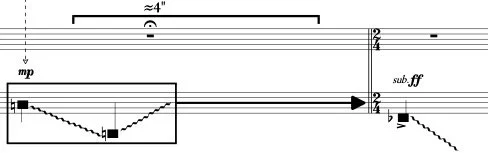
Figure 1. Notation in piano part, b. 7: keys scraped with paper object

Figure 2. Notation in vocal part, b. 29: rhythmic unfurling, then scrunching of paper
The appearance of noise-based sounds in “Ink and Blood” is justified musically: a new timbral layer, independent of the voice and piano, serves to articulate the formal anomaly that is this third movement, as described in the previous section. A sudden appearance of a first-person narrator in “Ink and Blood” calls for sonic material that feels raw and rooted in a harsh reality, suitably represented by non-resonant found objects. Unlike the timeless, sage-like perspectives of the outer haiku movements, this poem suddenly places listeners into a contemporary setting, almost as if it is Lau herself is on stage performing a recitation of her work.
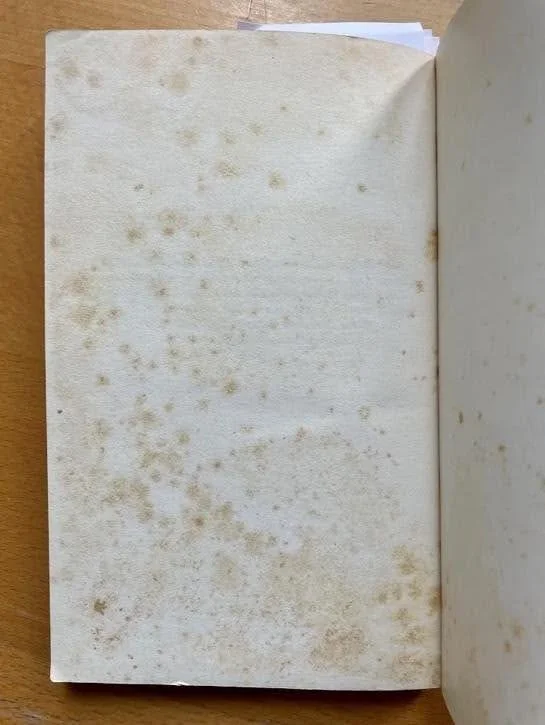
Figure 3. Photo by Jenny Lau accompanying text of “Ink and Blood”
The choice of paper objects, as opposed to other materials, was motivated by specific images featured in Lau’s poem. For Lau, encountering her late father’s handwriting on notebooks, as well as mundane objects such as envelopes and receipts, triggers an outpouring of grief. Ultimately, she connects the dark ink on these papers to the blood that links her biologically to her father: “My poetry, indecipherable from his. / This ink, our blood, joined up at last.”11 In the original publication online, Lau also includes a photo of a worn, stained page below the text of the poem (Figure 3),12 prompting me to consider the material of paper as an inextricable sonic element in Year of the Orchid.
Paper is an heirloom passed from one generation to the next, ranging from deliberate gifts of books and letters to inadvertent artefacts of daily life. While Lau’s poem “Ink and Blood” elaborates on her and her father’s visual marks on paper, its musical setting in Year of the Orchid attempts to broaden this notion of heirloom to include the sounds made with and by paper.
Sound Objects and Gamut Technique
The use of found objects expresses reminiscence and grief as related to physical heirlooms. A second technique, using fixed sound objects, lends itself to a general comment on the recurrence of memory and repeated hereditary features. “Ink and Blood” features sound objects used in a gamut technique, first attributed to the early works of John Cage. Famously featured in String Quartet in Four Parts (1949–50), Cage’s musical gamuts consists of chords of different lengths played by subsets of the quartet. According to Pritchett, this technique “…produced an ordering of sonorities that owed nothing to the world of harmonic progression” and created an atmosphere of stasis that was enhanced by the composer’s insistence on expressive restraint, with few dynamics and no vibrato.13
The approach to composing with fixed musical objects was also informed by the ideas of Pierre Schaeffer and his principles of Musique Concrète. Schaeffer developed a theory of abstracting recorded sonic fragments from the environment and reassembling them into new compositions: “More than simply a sample or bit of recorded sound, the sound object now suggestively appears to designate something ‘discrete and complete,’ the fruit of a mode of…listening to the fragment torn from the whole.”14 Devising sound objects prior to writing — objects which have a defined profile in all musical parameters (melody, harmony, rhythm, dynamics, etc.) — has significant implications on composition technique: “these bits of sound were radically discontinuous with the motive, in that composition with sound objects displaced the note or tone as music’s fundamental ontological unit.”15 In writing “Ink and Blood,” my technical focus was on assemblage of these larger units rather than note-by-note development and variation.
The decision to use this technique in Year of the Orchid was motivated by the observation that Lau’s poem features many repeated words. Several are prosaic, such as “he” / “his” / “him,” but which reveal the object of the narrator’s pleas. Others are more evocative, such as “scarred,” “blood,” and “halcyon sky.” Lau’s placement of these words across the poem is also significant, as each subsequent appearance gains expressive weight or suggests double meanings and new interpretations. For example, the word “blood” appears five times, each belonging to a different subject: the father, an impersonal “us,” Lau herself, then “theirs” — referring to family in general — and finally both Lau’s and her father’s, associated with the image of ink. Through a consistent musical setting, the progression in word meaning is made clear to the listener. Annotation of these repeated words in the text can be seen in Appendix 1.
I fixed these words (or categories of very similar words) in almost identical settings across the movement, no matter the number of repetitions. Like Cage’s approach to this technique, each of these gamuts contain specified pitches, rhythms, dynamics, and articulations for both the vocal and piano parts and recur as a unit. Table 1 contains an assorted sample of musical objects, twelve out of twenty-two in total. (Meter is unattached to the object and shown only as excerpted from the score.) This selection encapsulates the diverse musicality within the full gamut collection. The objects range in duration from a single beat to a complete phrase. They also span the spectrum from smooth to pointed articulation and feature solely abstract text settings as well as clear instances of text painting.
Table 1. Selected Fixed Sound Objects in “Ink and Blood”
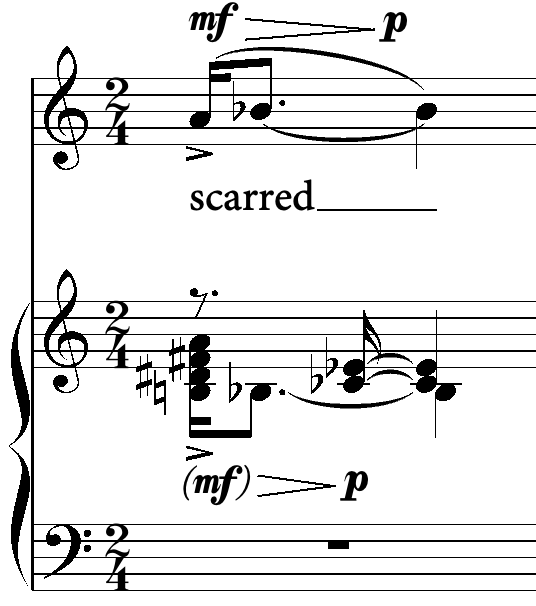
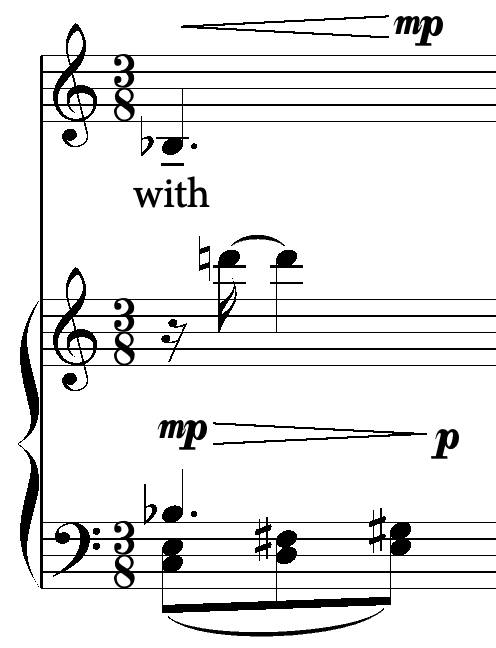
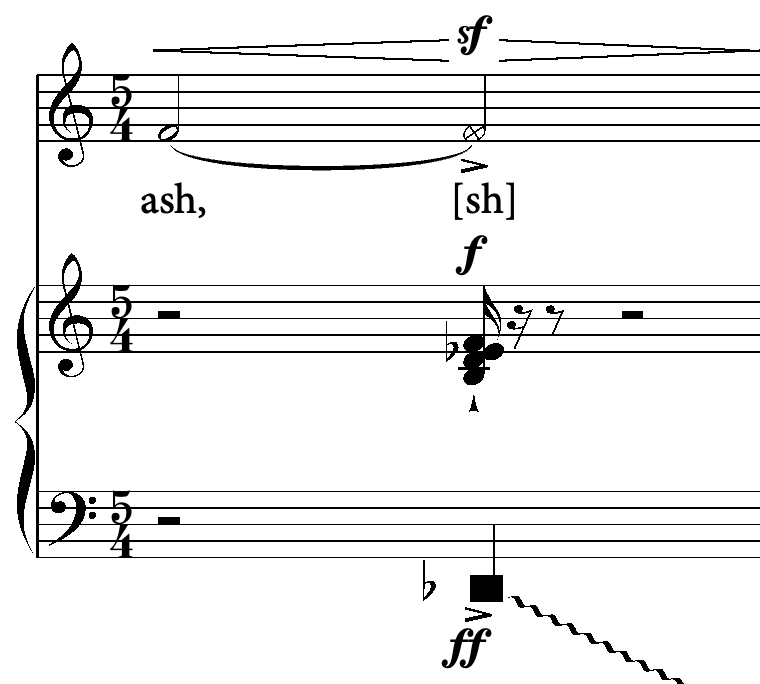
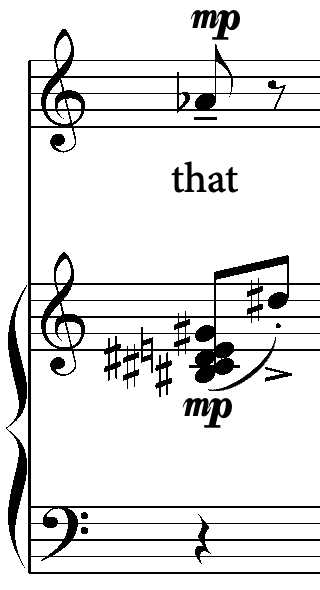
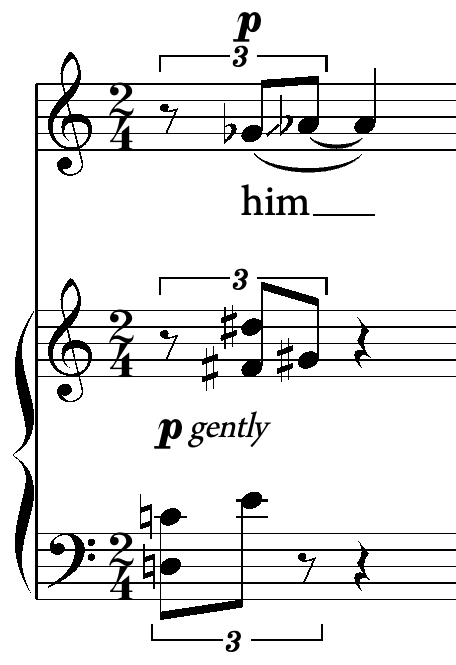
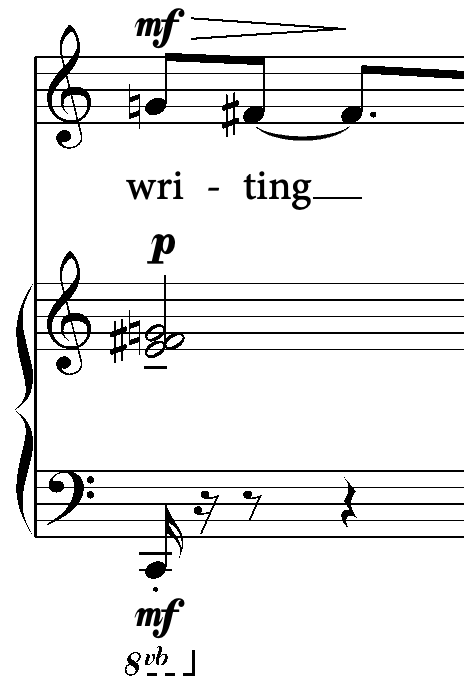
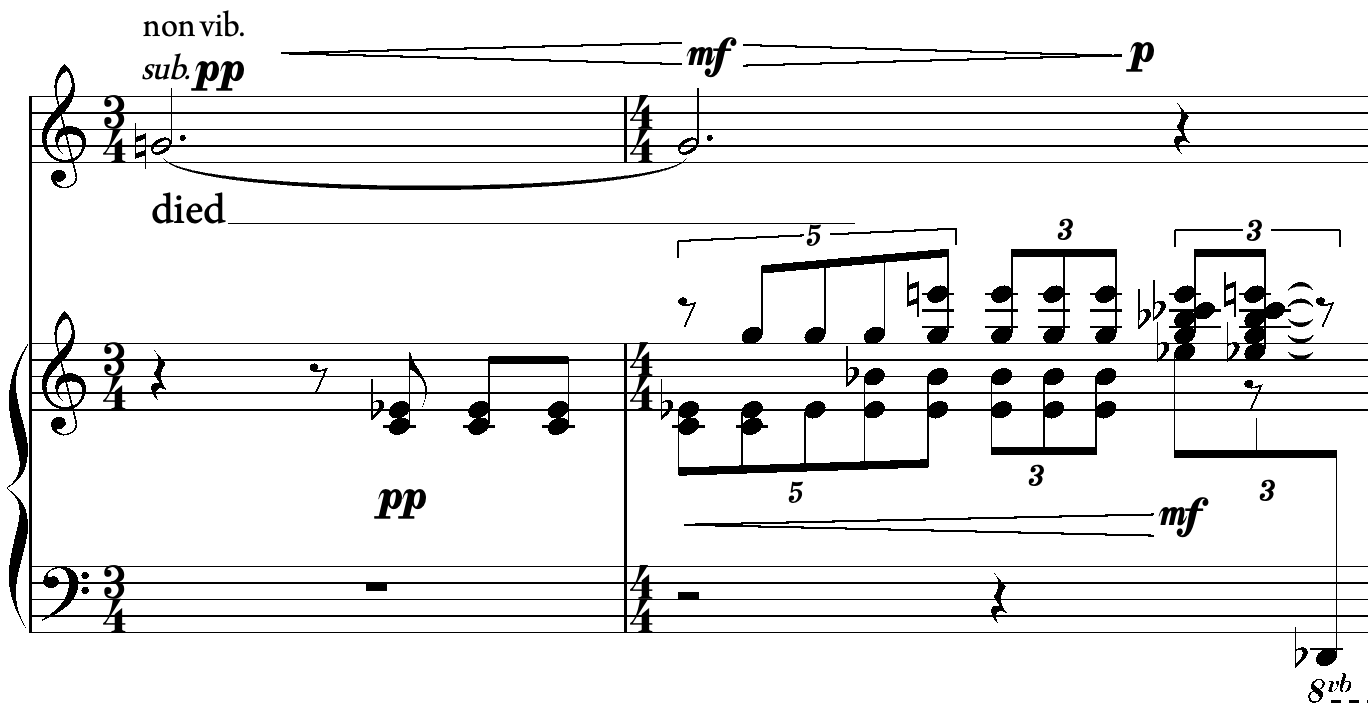
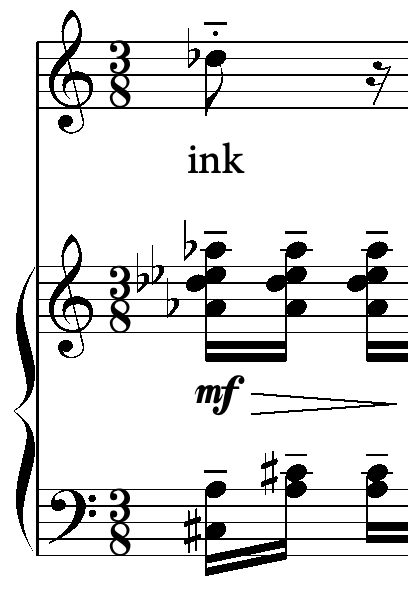
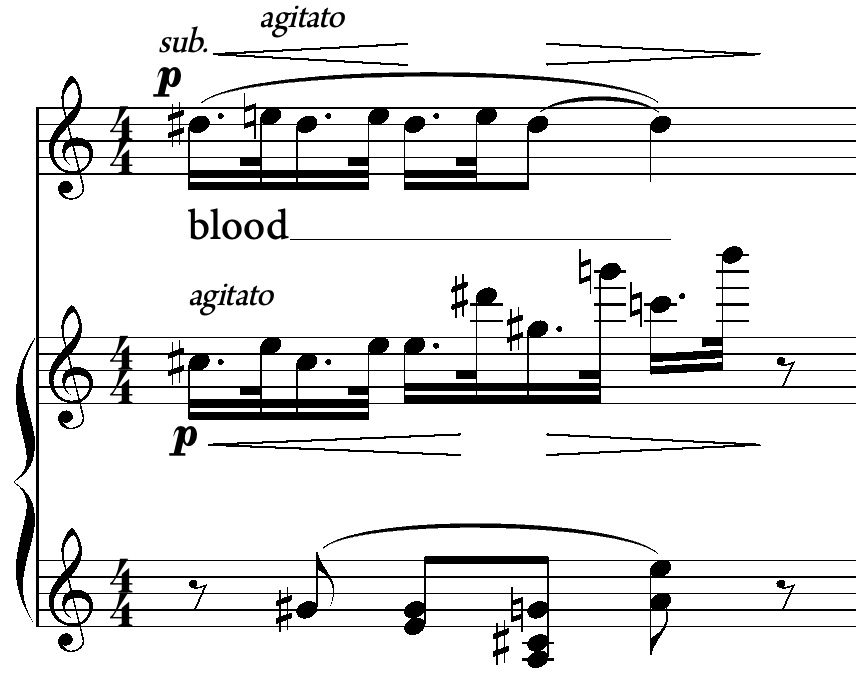
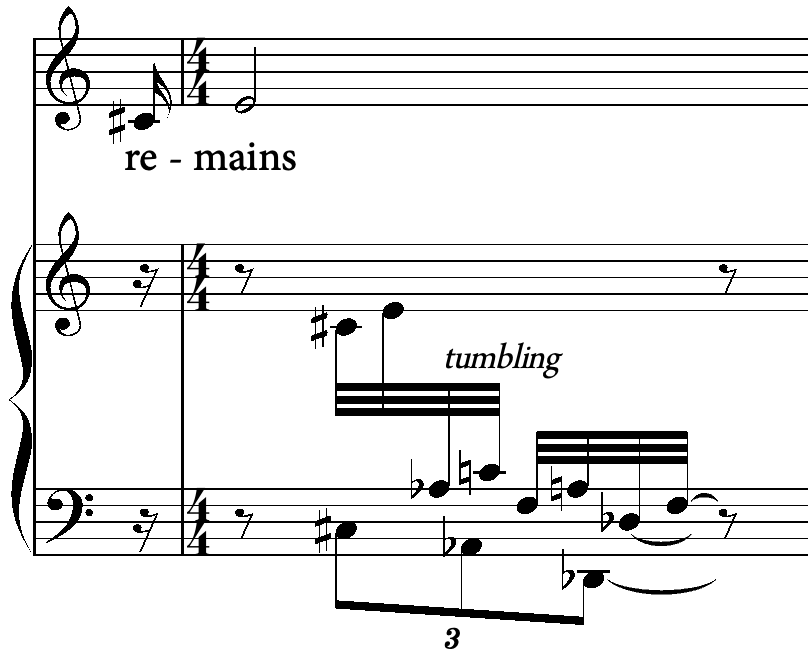
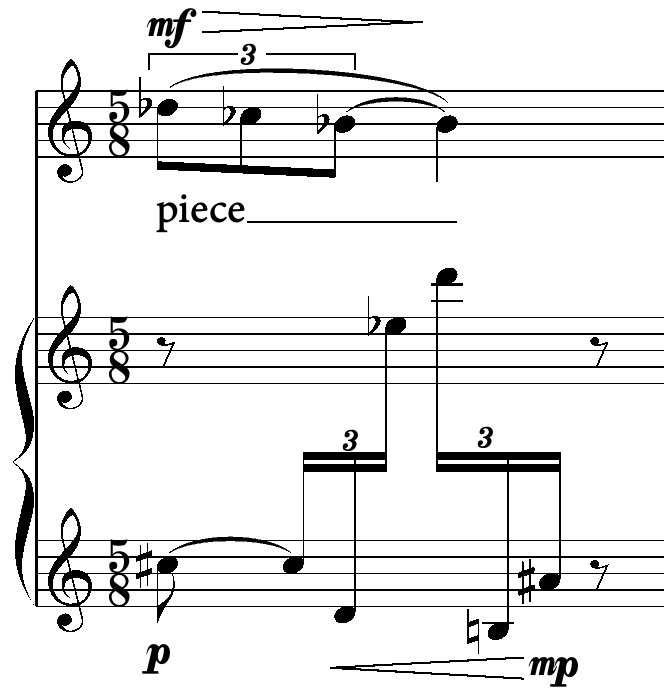
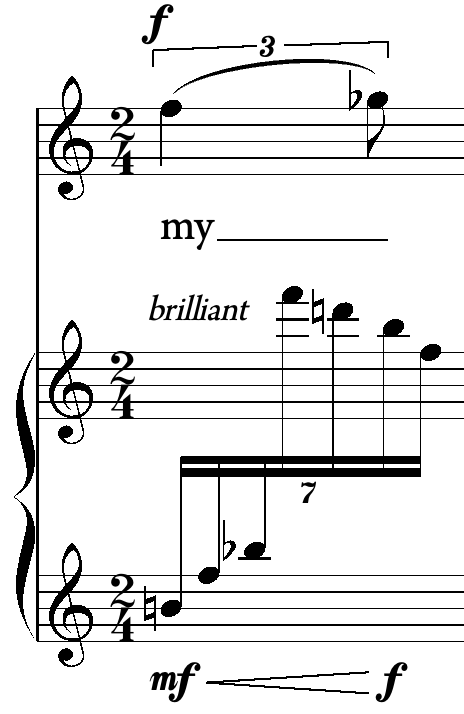
These twenty-two predetermined musical blocks stand out from the surrounding ‘default’ texture. This ‘default’ material opens the movement, and consists of the previously described piano guiro technique while the voice riffs on an E-flat minor triad in a recitative-like manner. The gamuts, then, contrast timbrally and harmonically with these passages. With few exceptions, the gamuts are the only places where the piano plays normally on the keys. As ordinario playing creates much louder dynamics than key scraping noises, it sets up structural relief between the two types of material. The gamuts also serve a harmonic function, as they are offset from the tonal center of E-flat minor anchored by the voice. These chromatic offsets provide harmonic tension while the intervening passages offer release back to E-flat minor. The harmonic changes begin subtly, with “scarred” (Table 1, Ex. 1) containing only a half-step, ornamental deviation from the chord tone of B-flat. However, later, on the word “blood” (Table 1, Ex. 9), a D-sharp to E-natural oscillation in the voice is harmonized with C-sharp minor, worlds away from the original key.
Since Lau’s text repetitions do not follow any pattern, metrical or otherwise, their corresponding sonic blocks appear seemingly at random. Therefore, after the initially gradual movements away from E-flat minor, the overall harmonic progression of “Ink and Blood” is non-linear. My harmonic language could be summarized as non-functional tonality: E-flat minor is firmly established in the background, while the gamuts constantly lead the listener away from the tonic — not via functional tonicization, but with the unpredictable order and pace of Lau’s text repetitions. In this way, my goals for using gamut technique in “Ink and Blood” do partially echo those of Cage, but only at the macro-level of the large-scale form. There is ‘harmonic non-progression’ in the sense that throughout the movement, the harmony hovers ambiguously around the tonic. It strays for brief moments, in recurring ways as fixed by the gamuts, but never truly modulates.
This irregular yet repetitive harmonic motion to and from E-flat minor is one way I chose to depict the sensation of remembrance: how we inevitably move away from an event in physical time, while our minds go back to the moment at unexpected intervals. It is a musical response to the text, where the narrator constantly refers to memories of a beloved “him” / “his” (Table 1, Ex. 5) that triggers “my” anguish (Table 1, Ex. 12). Lau’s direct reference to heredity in her poem also anchored my decision to follow through with strict repetition instead of building upon and developing the material: “(Observe how our eyebrows and fingers gnarl / in crooked likeness to the family tree. / Or how my brother’s sneeze can shake the doors / the way my daddy’s would sweep the floors.)”16 My musical objects scaffold the entire duration of the work, returning in new contexts like family traits repeating across generations.
Lau’s imagery and choice of repeated words imply another hereditary element that is amplified through gamut technique. Much like paper objects passed down as heirloom, the very act of writing also links the generations. In the poem, father and daughter have a shared disposition to putting words to paper — whether by hand or typing, in print or “in scraggly cursive.” A special subset of repeated words reveals this bond. First, “word(s),” “write” / “writing” / “write,” “ink” refer directly to the activity. These interact with the physical markers of heredity — “blood” and “blood and skin and bones” — with increasing proximity. By the final stanza, the confluence of these images builds to a climax, and it is the consistent, indexical relationship between music and text that make it audible. Lau’s unique syntax of ‘writing’ oneself in and out of existence cements the connection of writing to heredity. Towards the beginning of the poem, it is the father, who in death, “unwrote himself in the halcyon sky.” By the end, Lau concludes that we are destined “to / become the people who wrote us alive.”17
Where Cage’s desired effect in String Quartet in Four Parts was stasis, my setting of “Ink and Blood” seeks out a dramatic effect to portray the emotionally charged text. While Cage’s collection of sounds was highly related to each other, I devised a diverse collection, one that varied all musical parameters in service of text expression and even text-painting (seen in the repeated piano impressions of “ink” [Ex. 8] and the explosive release of “ash” [Ex. 3]). The wide-ranging texture and flexible pacing offered by this application of gamut technique results in a theatrical style that contrasts other movements in Year of the Orchid, elevating “Ink and Blood” as the emotional centerpiece of the work.
Conclusion
Two object-based techniques work together to create a song movement that attempts to portray Lau’s detailed imagery and emotional state in “Ink and Blood.” Found paper objects serve as the external element, inserting a percussive sound world to the duo of voice and piano. The literal sound of paper recalls physical heirlooms left behind by the previous generation — their handwriting and the stains of time leave an emotional impression on the narrator and onwards to the listener.
Fixed sound objects, applied with gamut technique, illustrate Lau’s textual form internally within the music. These repetitions of text setting depict memory during the grief process, as well as the echoes of inherited features. As Lau writes in the introduction of her poetry collection, “Something about being in a new place allows you to approach old memories, tentatively.”18 My application of gamut technique allows the same words to return in new musical contexts, linking the narrator’s present encounter of various physical items with memories of her late father and his relationship to those objects. While the emotional power of “Ink and Blood” is hardly tentative, I worked to create structural cohesion in the music that would operate subtly and effectively in the background.
By sonifying concepts of heirloom and heredity, “Ink and blood” disrupts the sense of identity established at the outset of the song cycle (and this article). Rather than embodying the voice of a seemingly independent, detached air orchid, the narrator suddenly shifts towards yearning and attachment, becoming someone who, in grief, is reluctant to let go of the past. Rather than a contradiction, this presents a multi-faceted and more complex view of the “terroir” of a diasporic individual. We are nourished by the community created amongst peers, as well as a steadfast connection to our ancestors.
Notes
1. See Appendix 1. ↩
2. Brooklyn Art Song Society, New Voices Festival 2025: Lost/Found III, https://tinyurl.com/5fcxecjz.↩
3. Jenny Lau, Late spring-summer 2024 poetry: A mini anthology, Eating for Longevity, Chewing on Identity (blog), September 6, 2024, https://tinyurl.com/3v3e3sya.↩
4. Ibid. ↩
5. Mvt. I intersperses spoken text within the texture, Mvt. IV features extensive fragmentation of words into component phonemes, and Mvt. V both stretches words beyond comprehensibility and sets text backwards. See accompanying score of Year of the Orchid, Appendix 2. ↩
6. Joseph C. Schwantner and Agueda Pizarro, Two Poems of Agueda Pizarro: For Soprano and Piano (Schott Music, 1981). ↩
7. “these intervals matter (2020),” Katherine Balch, 2020, accessed June 29, 2025, https://tinyurl.com/bdds3299. ↩
8. Pamela Z, “Pamela Z Excerpts From ACQUA,” September 19, 2014, https://tinyurl.com/mrxx4fka. ↩
9. Helmut, Lachenmann, Guero: For Piano (Breitkopf & Härtel, 1988).↩
10. The notation of the guiro technique in “Ink and Blood” is within the staff (see Figure 1), rather than taking the approach of Lachenmann’s tablature notation. This is for ease of switching to and from normal playing.↩
11. Lau, Late spring-summer 2024 poetry: A mini anthology.↩
12. Ibid. ↩
13. James Pritchett, The Music of John Cage (Cambridge University Press, 1996), 39-40. ↩
14. Brian Kane, “Pierre Schaeffer, the Sound Object, and the Acousmatic Reduction,” in Oxford University Press eBooks, 2014, 16. ↩
15. Ibid., 17.↩
16. Lau, Late spring-summer 2024 poetry: A mini anthology.↩
17. Ibid.↩
18. Ibid. ↩
Bibliography
Balch, Katherine. “these intervals matter (2020),” 2020. Accessed June 29, 2025. https://www.katherinebalch.com/these-intervals-matter.
Kane, Brian. “Pierre Schaeffer, the Sound Object, and the Acousmatic Reduction.” In Oxford University Press eBooks, 15–42, 2014.
Lachenmann, Helmut. Guero: for Piano. Breitkopf & Härtel, 1988.
Lau, Jenny. Late spring-summer 2024 poetry: A mini anthology. Eating for Longevity, Chewing on Identity (blog), September 6, 2024. https://celestialpeach.substack.com/p/late-spring-summer-2024-poetry.
Pritchett, James. The Music of John Cage. Cambridge: Cambridge University Press, 1996.
Schwantner, Joseph C., and Agueda Pizarro. Two Poems of Agueda Pizarro: For Soprano and Piano. Schott Music, 1981.
Z, Pamela. “Pamela Z Excerpts From ACQUA,” September 19, 2014. Accessed June 28, 2025. https://www.youtube.com/watch?v=kuItVaaLlGs.
Appendix 1
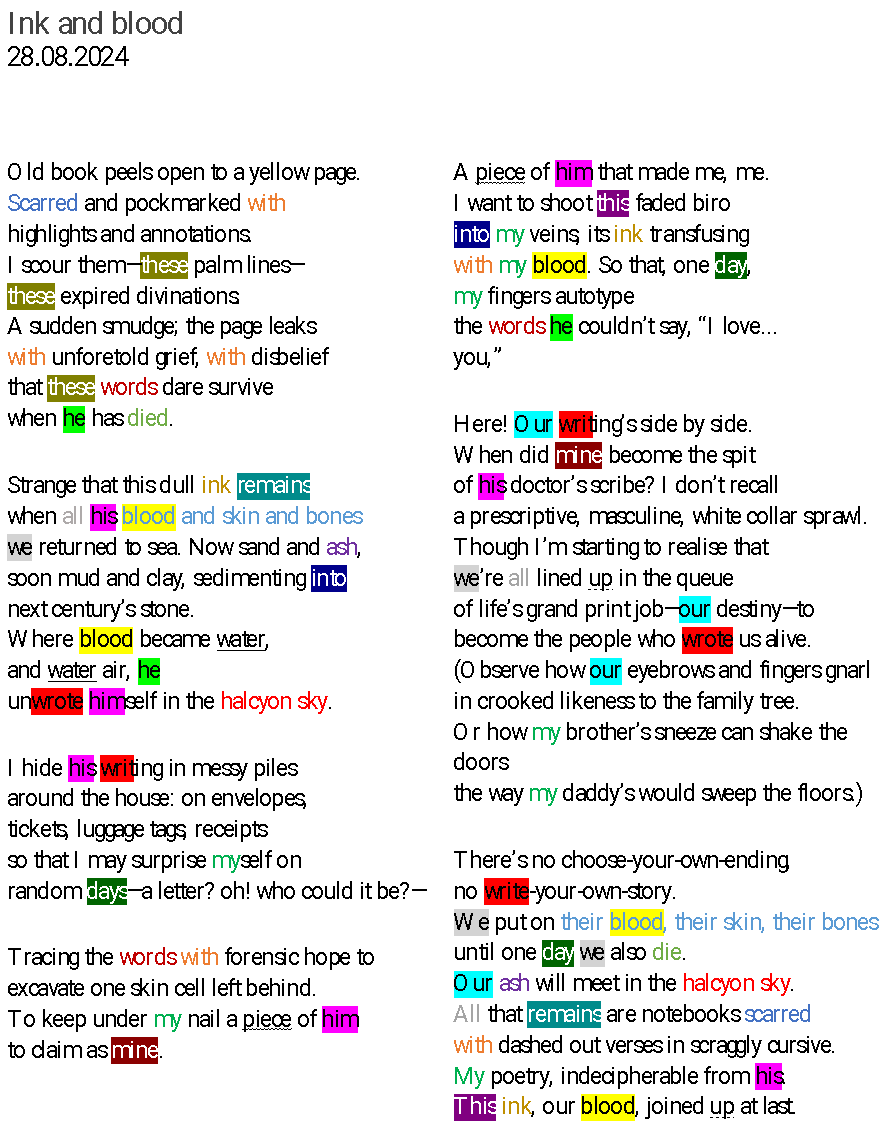
“Ink and Blood” by Jenny Lau with author’s annotations of repeated words
Appendix 2
Score excerpts from Year of the Orchid (click for PDF)