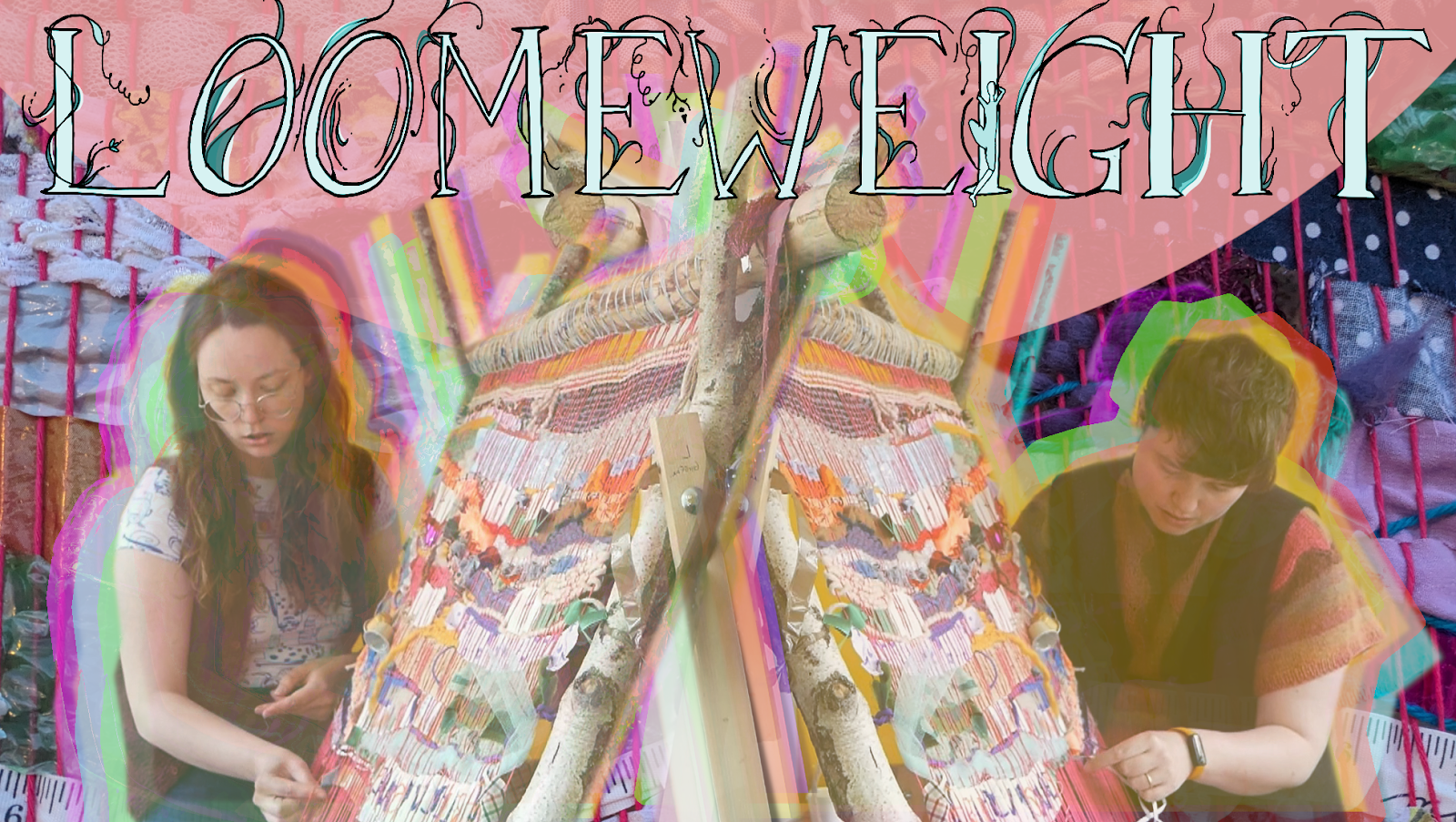
PATRICIA AUCHTERLONIE with HESTOR DART | casting on: loomeweight I
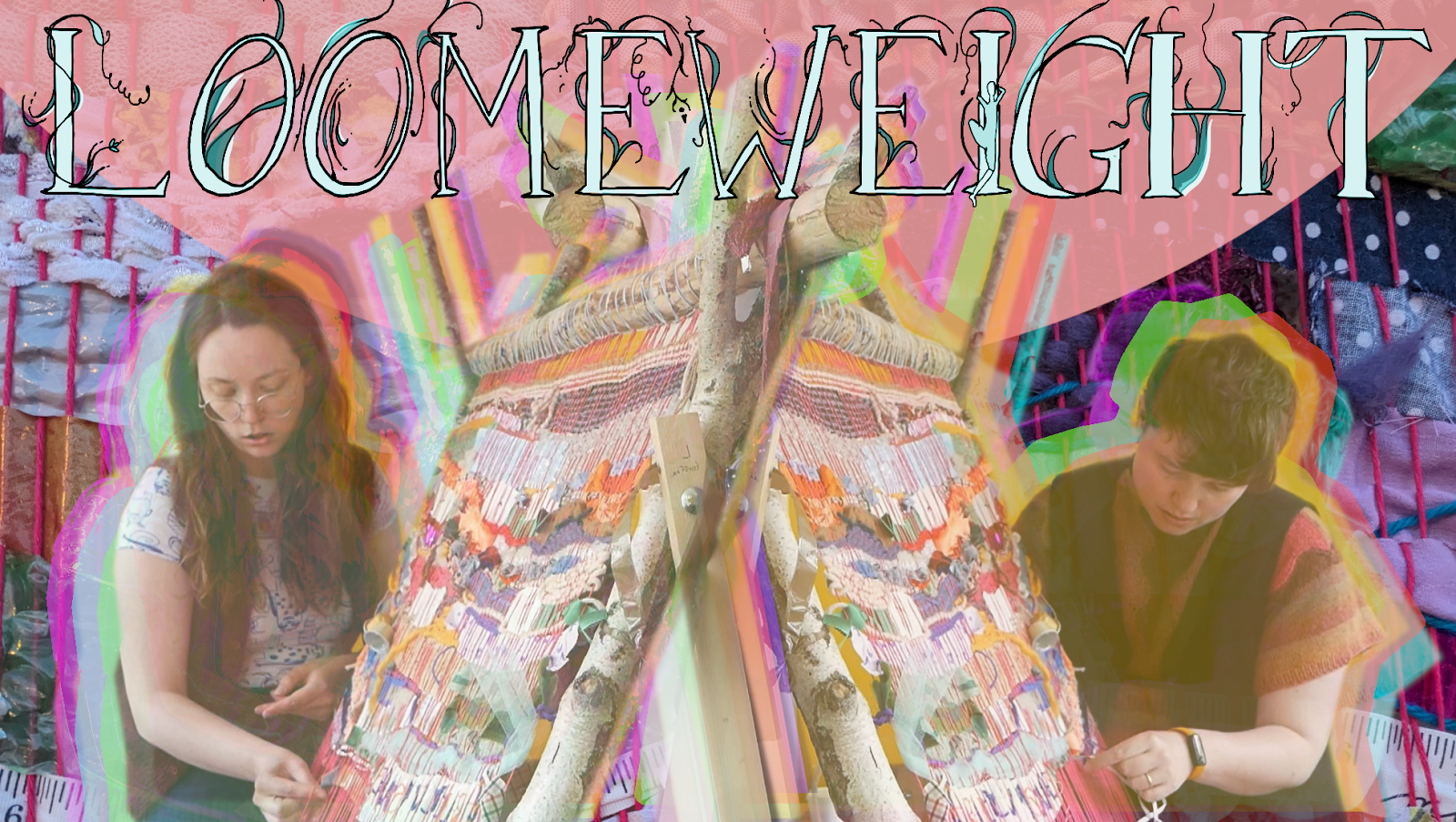
Together with Hestor Dart, Patricia Auchterlonie discusses their first collaboration, loomeweight I: a slow undertaking, a performance project that combines textile work and slow, deliberate singing.
Glossary:
Warp: The threads stretched vertically on a loom, over and under which other threads (the weft) are passed to make cloth.
Weft: The horizontal threads on a loom that are passed over and under the warp threads to make cloth.
Hagstone: A stone with a naturally worn hole through it. In folklore, these were thought to protect against evil and keep witches at bay – they were often hung in the entryways of buildings and barns. In some traditions, the hole was supposed to be used as a lens through which to see other worlds or spirits.
loomeweight is a series of performance projects for voices and textiles created by Patricia Auchterlonie and Hestor Dart. This paper deals with our first collaboration, loomeweight I: a slow undertaking, made to explore slow singing, slow crafting, and slow sharing. If you had come to see loomeweight I, you’d have seen a loom, two weavers, and a pile of trash heaped at their feet. You’d have seen garbage being lovingly looped in and out of a bright pink warp. You would have heard voices weaving in and out, responding, resisting, playing, entangling in an improvised collaborative musical dialogue.
loomeweight I is a slow, small, intimate ritual. loomeweight I is a gentle, insistent opposition to things that are fast, shiny, instant, and marketable. loomeweight I sees voices as yarn and yarn as voices. loomeweight I is a home for trash, a welcoming-in of the discarded and the forgotten. loomeweight I is a home for ears, a welcoming-in of all listeners and watchers.
The tapestry of loomeweight I was woven over the course of a year. We wove in a community cafe, a heavy metal bar, for a contemporary music audience, at a performance art festival, and to the thumping accompaniment of a distant ska band. We wove for silent watchers, noisy watchers, and even to no watchers. The loom’s first outing was a trial run for Eavesdropping Festival, hosted at Cafe Oto in London. We responded to a call-out for their annual symposium, which that year explored the theme Experiments in Failure. Neither of us had ever made anything like loomeweight before, and we thought it was possible that we had what it took to make a failure. In our application, we wrote that we intended to use “failure as a creative tool, making an object with no intention of perfection or even completion and by using materials that have previously been considered to have failed their purpose… we embrace the concept of failure as freedom, we release our piece from the pressures of success, revel in the enjoyment and slowness of ‘amateur’ crafts and refuse to use our craft or our voices as a hustle.” A pair of twenty-minute trial runs over the course of two days were greeted with warmth and generosity from the symposium participants. They affirmed: it was not a failure but, in fact, the curious beginning of an idea worth exploring.
After the symposium, loomeweight I travelled across the UK and Latvia, despite being heavy and difficult to transport. We carried a huge bag full of sticks, rocks, and garbage on buses and trains – it was even allowed on a plane, although it did not come out on the baggage carousel after we landed and was only returned to us within hours of our performance. We wove for nearly six hours (too long, it turns out) in the Bonnington Centre Community Café, where we were welcomed by neighbours and friends, drifting in and out with cups of tea, watching with open ears. We wove in Helgi’s (a much-loved metal venue) for the fans of the experimental folk-duo Milkweed. We wove at Nozstock The Hidden Valley for wandering partygoers; some watched with bemusement and made their escapes, others dallied curiously. We wove at Riga Performance Festival Starptelpa in a side alcove while the public wandered by. We wove at Huddersfield Contemporary Music Festival to a respectfully silent room that somehow turned our cosy ritual into an oddly formal act of performing. We finished the weaving back at the Bonnington Café in January of 2025, where we cast off the tapestry, a physical embodiment of the time shared between us and those who came to watch us weave.
We wanted to build a loom that we could sing with. We wanted a song to sing with the weaving. We wanted a weaving to make while we sang.
The final fabric is a record of the way our voices entangled, the ideas we developed, the responsibilities we shared. loomeweight is intentionally a fundamentally egalitarian, collaborative project with vulnerable, risky comaking 1 at its core. Performing loomeweight I is an intrinsically entangled experience: the weft is woven just as the voices are woven. We work across the length of the loom, crossing each other’s work - we pass sound back and forth, encouraging, coaxing, and changing each other’s singing. loomeweight I is personal, deliberate, and small, unfurling slowly over long performance durations and, indeed, over the course of a whole year. loomeweight I was designed to invite people in, to invoke curiosity, to welcome them to witness the slow process of turning garbage into textile and air into sound.
The earliest of all looms date from the 5th millennium BCE 2 – for thousands of years, we have been weaving fish nets, fabric for clothing, blankets, and even sails for boats. Different styles of looms can be found throughout the histories of cultures across the world. The loom was also one of the first machines to be significantly changed by industrialization: “Think of the Industrial Revolution and coal and steel will spring to mind, but it would be more accurate were we to picture instead the busy whir of threaded looms and cavernous factories choked with cotton dust.” 3 Weaving has transformed over the millennia - once it was the domain of women in the home, slowly passing shuttles back and forth to clothe their families. Now it is undertaken by fully mechanised looms in colossal factories which produce vast quantities of low-quality textiles to be worn and discarded.
The structure of our loom is an homage, an imagined version of a thing-which-once-was, a gesture to the remnants of looms found forgotten and crumbled in the dirt by archaeologists. loomeweight I is an adapted warp-weighted loom, an ancient style of frame loom which can be found in sites dating back to the neolithic period. 4 Warp-weighted looms are made from four large pieces of wood, threads, and a collection of iron, clay, or stone weights, as shown in Figure 1. They could be set up anywhere with a flat, empty wall and paused – rolled up / unrolled – whenever the work could be undertaken. Large warp-weighted looms required two weavers to pass a shuttle back and forth between the opposing warp threads, as can be seen in depictions on Greek pottery (Fig 2). In the modern era, warp-weighted looms are mostly only in use for historical re-creation projects, having long been replaced by more efficient mechanized looms in cultures across the world.
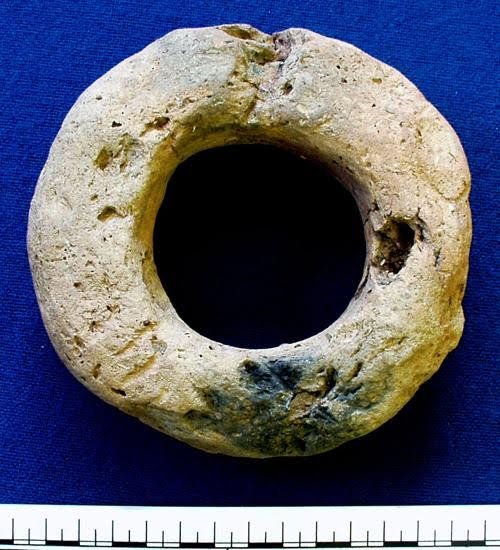
FIG. 1 Loom Weight, ca. 8th–5th c. BCE
From: "Loom Weight, Clay." Ca. 8th–5th Century BCE. Archaeological Museum of Kavala, Greece. Photo by Dan Diffendale.
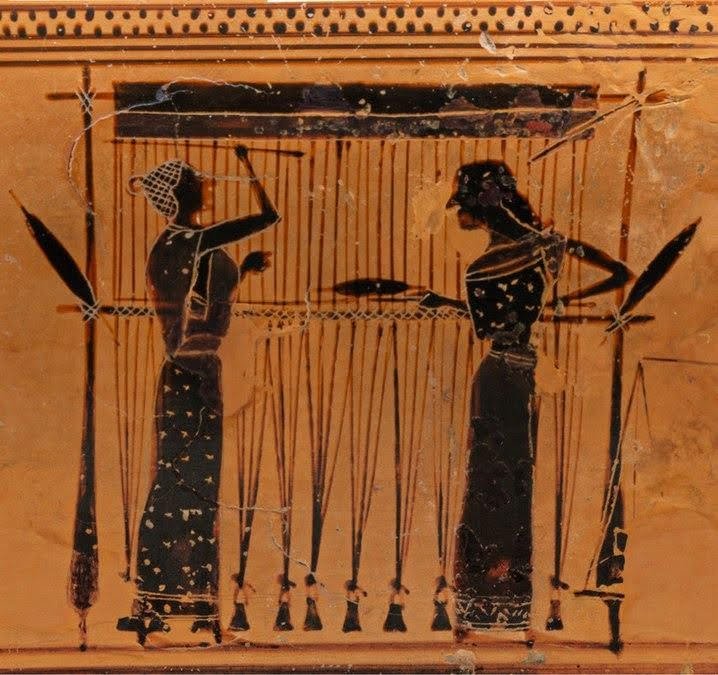
FIG. 2 Two Women Weaving on a Warp-Weighted Loom, ca. 550–530 BCE
From: "Two Women Weaving on a Warp-Weighted Loom, Detail from an Attic Black-Figure Lekythos." Attributed to the Amasis Painter. Ca. 550–530 BCE. Terracotta. Musée du Louvre, Paris. Image cropped from original, Wikimedia Commons.
We built loomeweight I with the help of a few diagrams and some YouTube videos. Our loom was made from materials we foraged: fallen wood from the forest for the frame and hagstones to weight the warp. We only sought to make the simplest version of a working loom, filling in gaps and problems with our own instincts. We replaced the traditional evenly-weighted, handmade loom weights with hagstones gathered on the beach, hanging them through holes worn in by the ceaseless pounding of the sea.
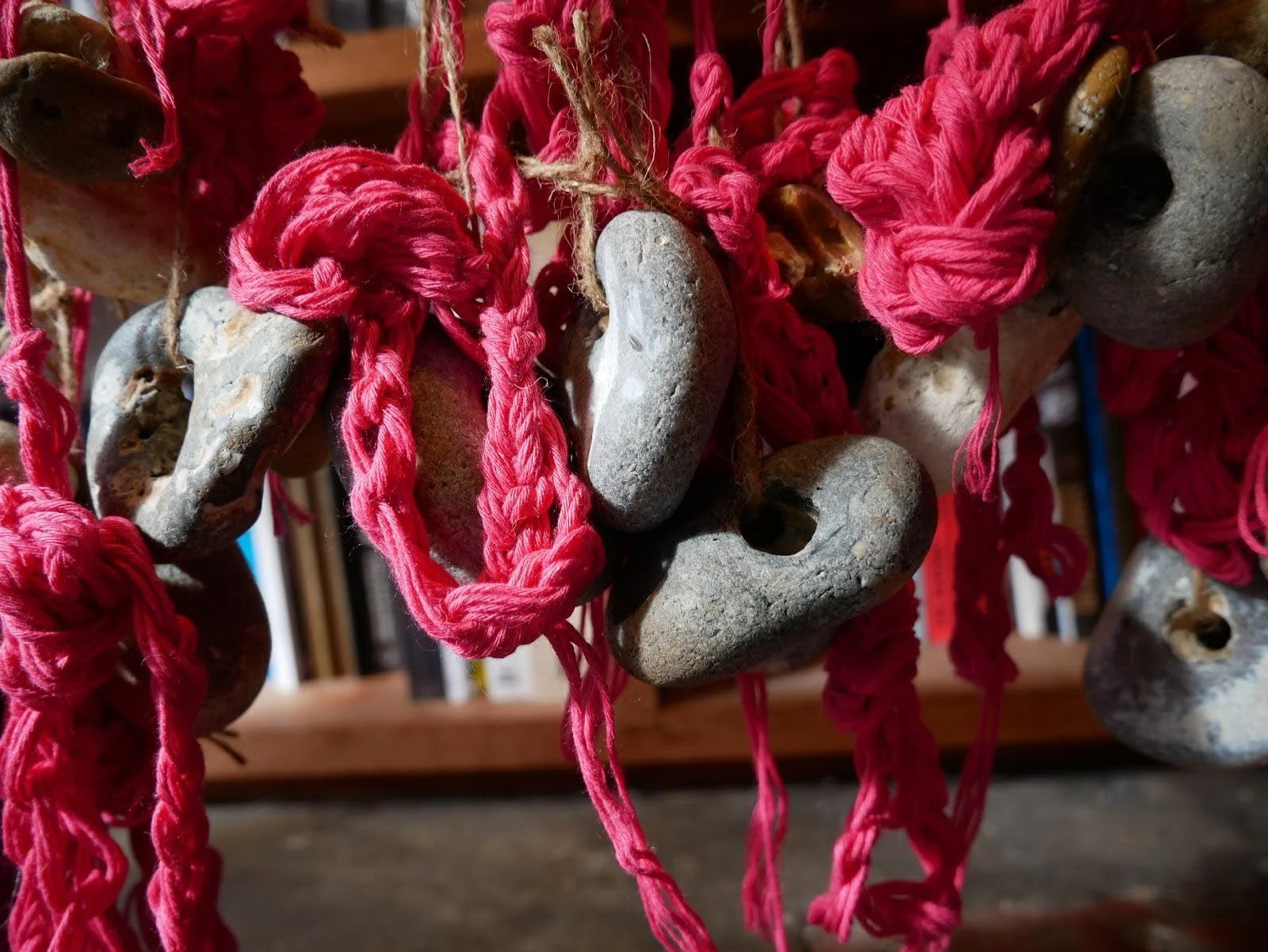
Close-up of hagstones
After the foraging, we began construction. We started with wood: peeling bark, sanding birch, measuring and drilling holes, sawing. After the wood was ready, we built the frame. Then came the warp. Warping is careful, diligent work. Threads were passed back and forth from one hand to another until we had 68 pairs over 3 metres in length. The threads were hung, counted, detangled and lashed to the frame of the loom. The warp was weighted: we tied the dozens of found hagstones to the ends of the threads, their bulk giving tension to the loose warp, the tension that keeps weft materials in place. Building the loom was slow and satisfying (despite some trouble-shooting and moments of uncertainty!). The building process felt like a crucial part of setting the conditions for devising our own ritual of slow performance.
We wanted to sing of the small, the detailed, and the curious. We wanted to make a song of our own in memory of what has been lost.
How was our loom going to sing? We tried filling our ears with weaving songs: the Gaelic tweed-waulking songs of Scotland, cotton-songs from the Sumi Naga in India, ramie-songs of the Saisiyat people of Taiwan, the pattern-singing of Persian rug makers. We knew that none of these songs belonged to us. We were left with the tangled threads of lost tradition and broken aural/oral histories. Neither of us learned to weave from our parents, neither did they from theirs. There was a history of weaving in our Scottish families – inherited moth-eaten woollen blankets carefully stored in plastic bags for a generation – but our hands have not learned from the hands of those who wove before us. There was no Gaelic sung in our ears. We wanted to engage with this loss in a playful and curious way. We moved towards creating our own imagined/fictional wordless musical language. The music of loomeweight I is improvised, unfolding over the set duration of the performance. The sounds we wander through are the cousins of ones borrowed gently from the ghosts and misrememberings of other weaving traditions: we copy each other, we call and respond, we elaborate, we hocket, we diverge, we sing together and we sing alone. The improvising happens while we weave – this pairing demands a level of present-focus which clears the mind of all else. There is no room to plan the music, only to make sound and to move the fingers. Performing loomeweight I is a symbiotic experience; the duo action of sound-weaving becomes almost a living organism of its own. Live-making the sound together feels like a generous, open, playful act. The weavers of loomeweight I are like two threads held together – both making and singing – entangling a pile of trash into a tapestry and a pile of sounds into singing.
“The vulnerable, hocketing improvisation came in short, sporadic phrases that bounced off the walls of the room, leaving us waiting to see what would be woven and sung in the next phrase. The performance was the pinnacle of intimacy, and bearing witness to the beauty of their experimentation was insight into the beginning of a long and beautiful collaboration.” - Michelle Hromin5
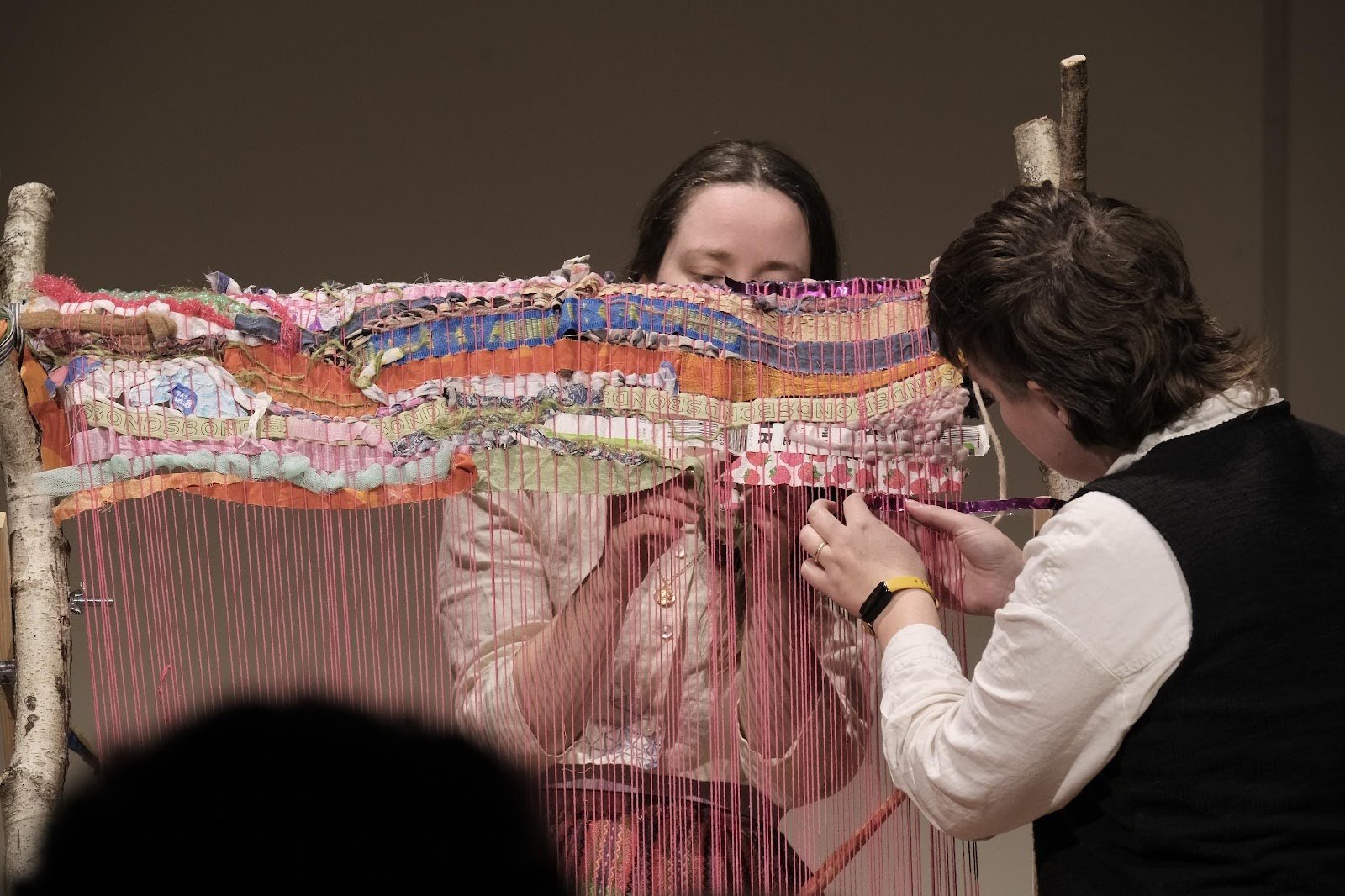
at Huddersfield Contemporary Music Festival
From: "loomeweight © Point Of View (49)." Photograph. Huddersfield Contemporary Music Festival
We wanted to share the joy and patience of making: we wanted to find that joy and patience in our singing.
loomeweight was born from a series of conversations about an unresolved sense dissatisfaction we felt in our artistic lives. We are both classically trained singers working in experimental/new music but, increasingly we were both looking for something that felt different. Craft, for both of us, was something we did as an act of joy with no pressure to be good or successful. It was also something we saw as somehow separate from our work as singers, as a hobby rather than a serious pursuit. It was a form of making where we felt more free; singing was comparatively full of weight and worry. loomeweight came from an earnest desire: we wanted to make our singing feel like our crafting. We wanted to find ownership and joy, and to feel free to experiment. Neither of us are afraid of slipped stitches or bad technique in our crafting. Why shouldn’t our singing enjoy the same forgiveness? Why couldn’t singing become more like mending a moth hole in a favourite jumper? Why couldn’t opening our mouths feel like passing yarn over yarn?
We wanted to give refuge to the thrown-away. We wanted to spin straw into gold. We wanted to hold in solidarity that which is undesirable.
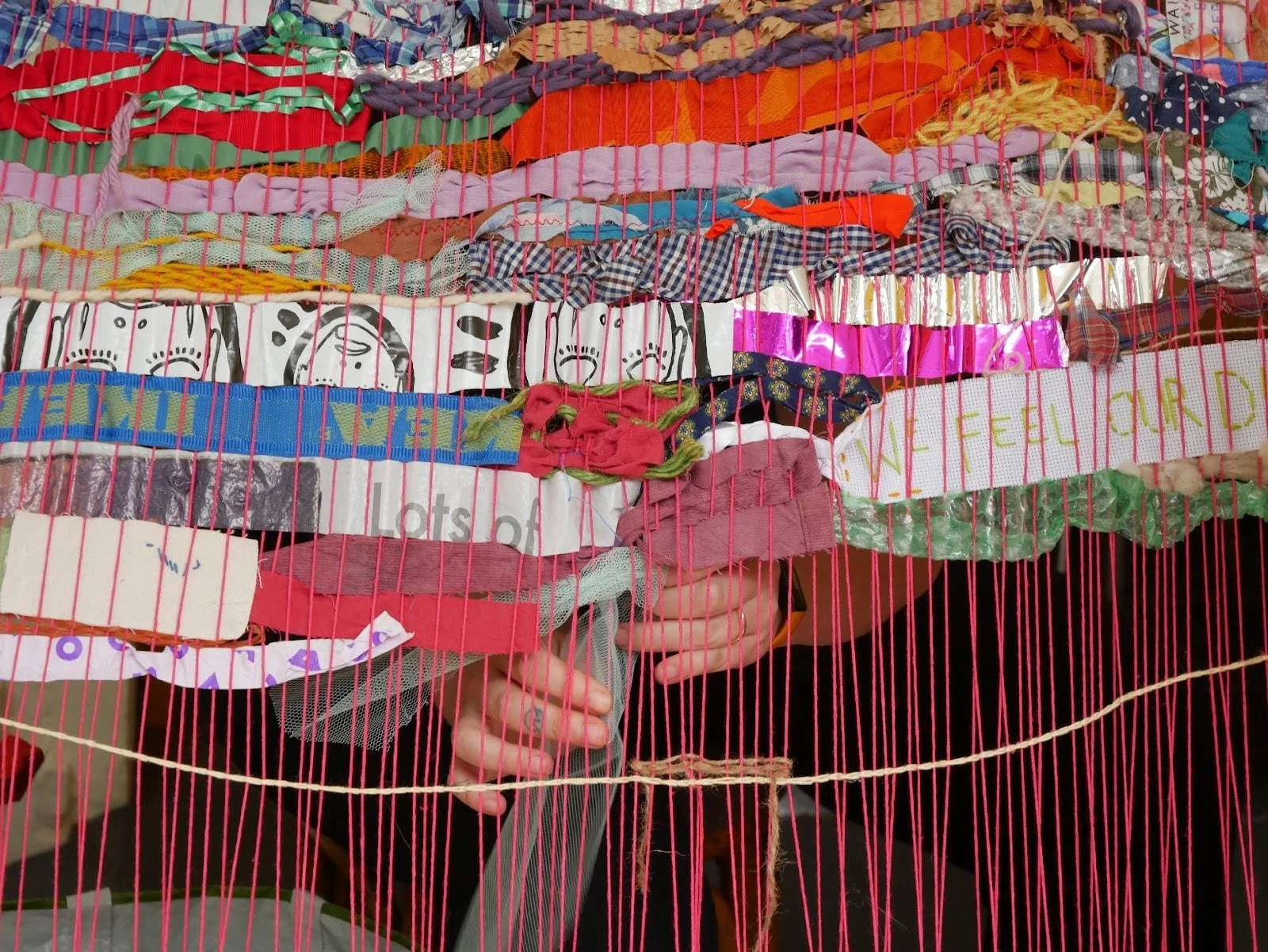
loomeweight I is a refuge for garbage: bits of leftover wool from already-knitted jumpers, scraps of old clothing, strips of plastic carrier bags, ribbons, bubble wrap, shoelaces and paper bags. The weft is woven of identifiable, familiar leftovers, each with a previous life: shopping bags, holey t-shirts, mail packages. loomeweight I rescues the unwanted, welcomes the scraps lovingly, shows them that they are still useful and beautiful. This welcoming-in explores the omnipresent theme of ecological collapse in our troubled time. loomeweight I lives inside the ubiquity of garbage, taking as a starting point the desire to repurpose and remake. Trash becomes a natural resource of its own, calling from street corners and the pockets of friends on its way to the loom. A piece of broken fishing rope found by the sea, a plastic bag idling on the road, a rubber glove that leaks: collected, cleaned, woven. This foraging and rescuing allows us to live with the trouble6 of waste and its ecological impacts at the forefront, not as an afterthought.
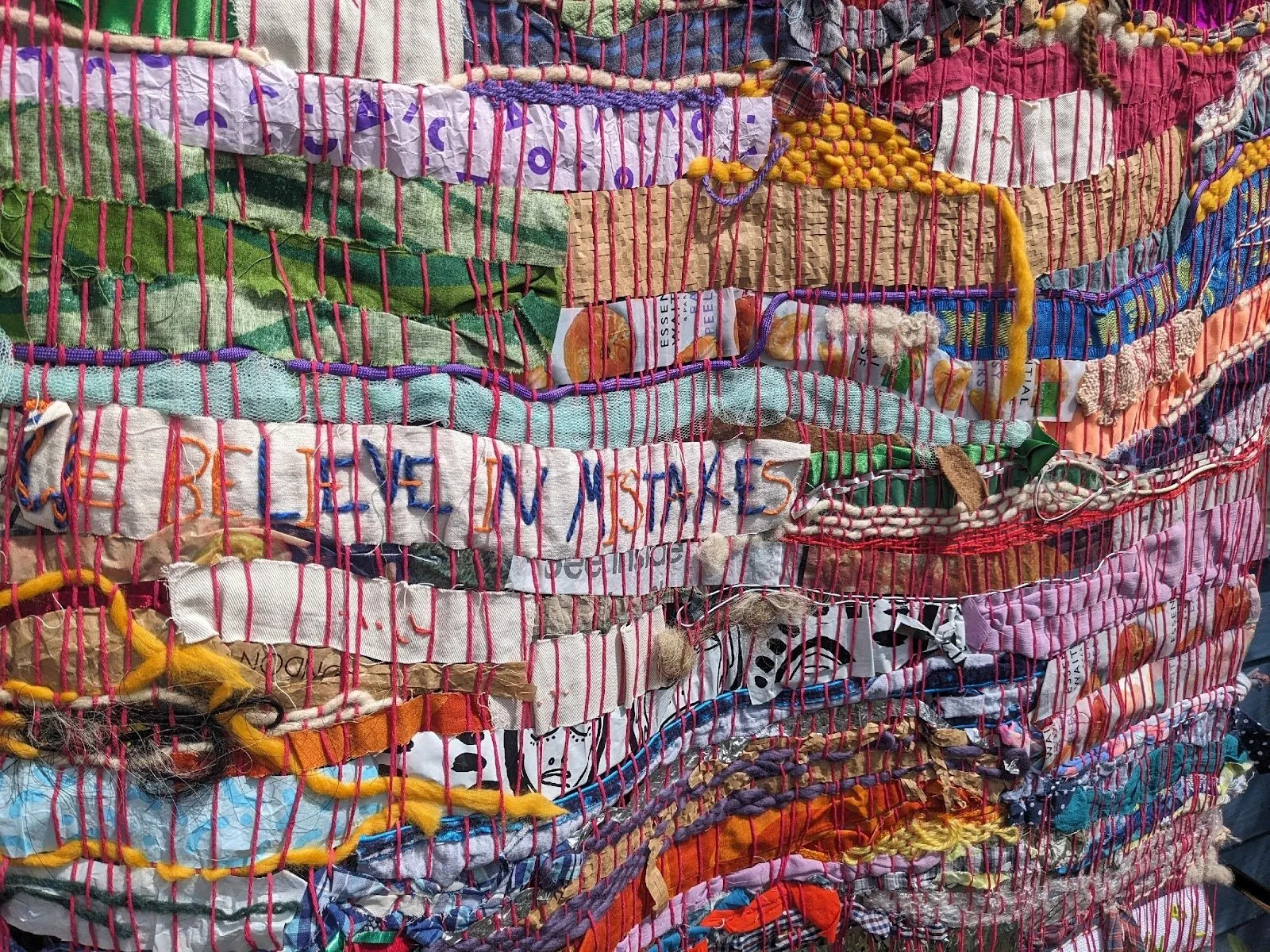
The weft
“We – all of us on Terra – live in disturbing times, mixed-up times, troubling and turbid times… Our task is to make trouble, to stir up potent response to devastating events, as well as to settle troubled waters and rebuild quiet places. Staying with the trouble requires learning to be truly present, not as a vanishing pivot between awful or Edenic pasts and apocalyptic or salvific futures, but as mortal critters entwined in myriad unfinished configurations of places, times, matters, meanings.” - Donna Haraway7
We wanted to share the loom: to pass the threads over each other, to open our mouths in a room with others. We wanted to welcome the curious ear and the curious eye.
loomeweight I was conceived to be witnessed. It was intended for eyes and ears, for watchers to watch. As formally-trained performers, we so often undertake the strange, ordered rule of the stage: applause - entrance - bow - sing - bow - applause - exit. We wanted to make a new kind of ritual: the fingers pass over the yarn, the voices pass over each other. The space is held, the weft is woven, the watchers are welcome. The watchers are not obliged. loomeweight I lives in the vulnerability of simply opening the mouth and allowing the sound to be made. The weaver has nothing to show, nothing to tell, only something to do. The weaver’s eyes and ears are differently, fully occupied: threads must be chosen, they must become entangled, the call of another voice must be answered.
Perhaps it is best for a watcher to explain the experience of watching:
“The singers are not performing for us, waiting for our response, but working with each other to create an experience we act as witness to. It works best without formality, to be able to walk in and out of the room, get coffee, sit on the floor, be part of the sea of material at their feet, the tide line. We are in the house of the weavers. They carry on working, untangling the threads, deciding what comes next. Outside the window we can see the world continuing, the cars, the pollution, the world drowning under the weight of our consumption. Inside we are witness to a new weaving, to what sounds like a surprising incantation, calling into being a space for reflection, for questioning, a space that gives back this intimacy and quiet. They are there, we are in the space they have created. Their own space, but we are invited to enter.”- Jenny Vuglar8
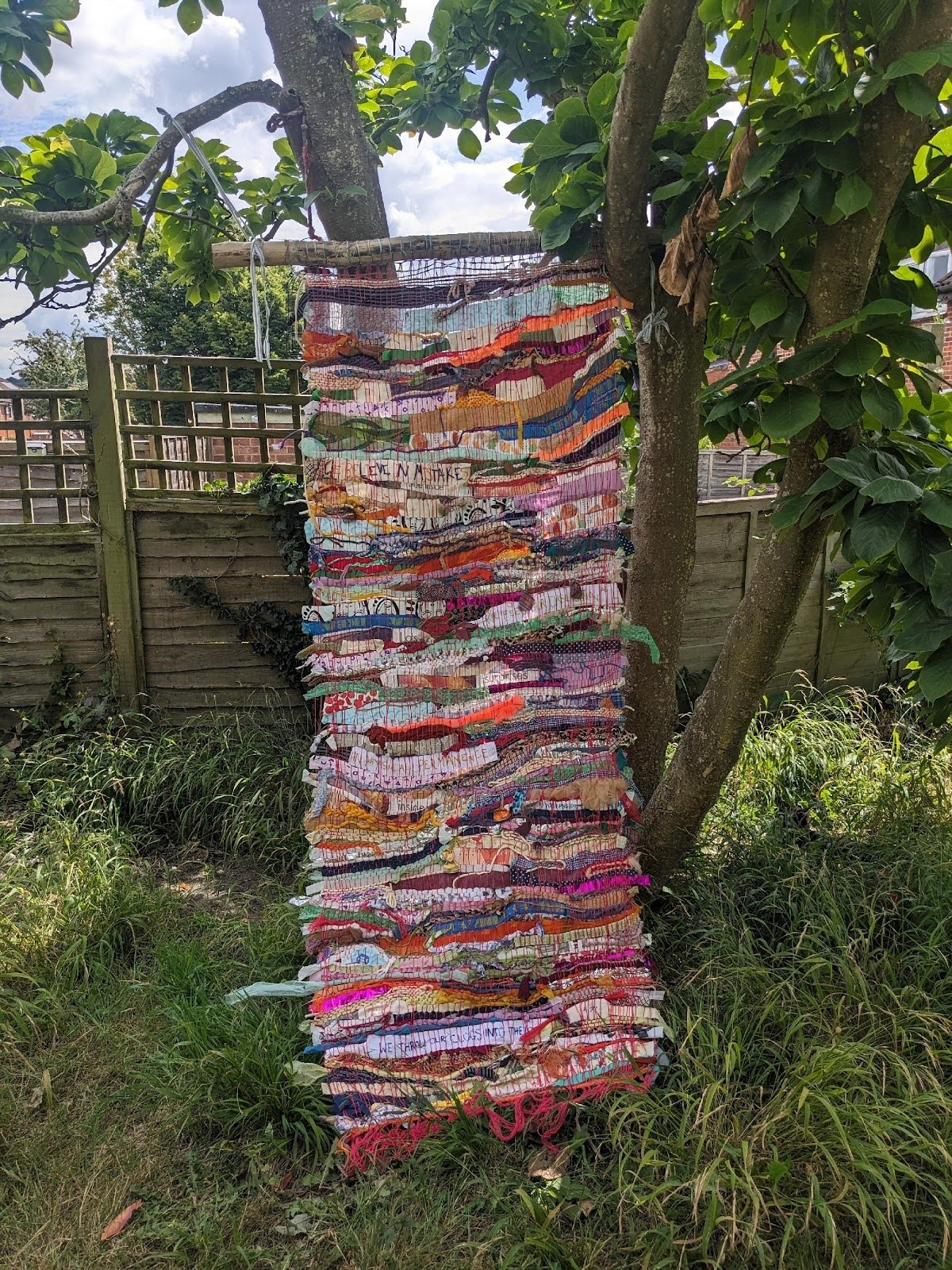
The completed tapestry
We finished loomeweight I in January of 2025, casting off the weft and cutting off the hagstones in a room full of friends and family at the Bonnington Centre in London. All woven fabric has a limited length given by the warp threads; we wove until we finished the threads. We wove nearly 2.5 metres over the course of nearly a year. The finished tapestry is a record: fragments from the journey are tangled into the fabric: baggage tags and artist wristbands, clementine wrappers from when clementines are ripe. The cloth stands as a catalogue of slow work, a catalogue of the now-evaporated sounds we passed back and forth between us while we wove. It stands as a monument to garbage, a celebration of the forgotten and discarded. In all of this, there is something wormy and small that we will continue to explore: loomeweight is not intended to be a grand idea but instead a very personal one, something that chips away at a larger world of formalities and expectations. loomeweight I is made from the ghosts of other things that once were useful and beautiful made useful and beautiful again. loomeweight I is a sibling to forgotten ancient machines of sticks, thread and stones. loomeweight I exists as a memory of sounds and objects that have been, a record of the unrepeatable. loomeweight works in opposition to correctness and seriousness. loomeweight is a celebration of trash. loomeweight belongs to us. It feels tender and private. Those who come to witness loomeweight are welcomed: they become a part of the weaving and the calling. loomeweight is vulnerable. loomeweight is impractical. loomeweight is playful. loomeweight is persistent.
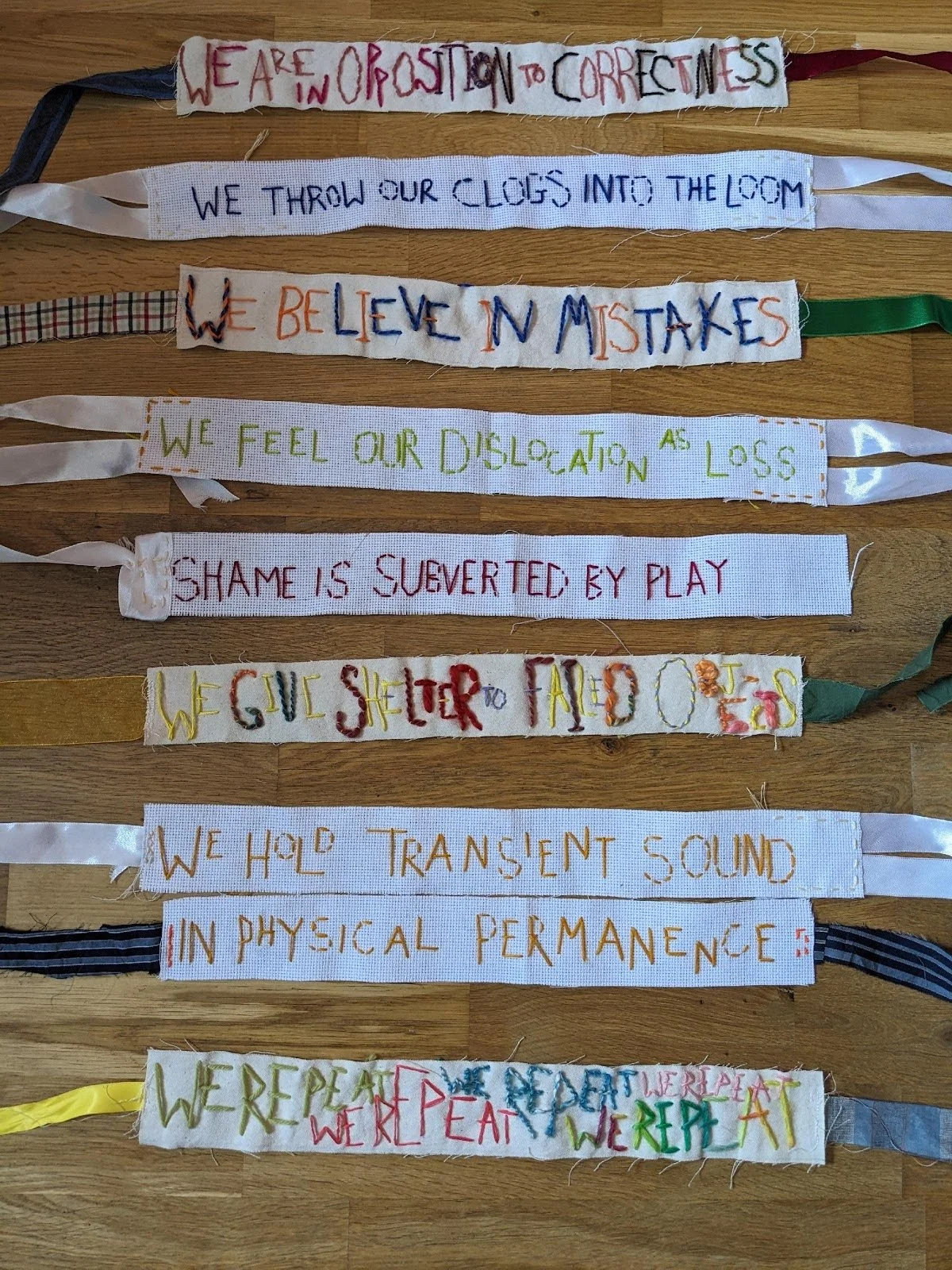
Embroidered statements by the artists
We are in opposition to correctness
We throw our clogs into the loom
We believe in mistakes
We feel our dislocation as loss
Shame is subverted by play
We give shelter to failed objects
We hold transient sound in physical permanence
— we repeat we repeat we repeat we repeat we repeat —
loomeweight II is currently in development and has just finished an artists' residency at Hawkwood Centre in February of 2026
Notes
1. Haraway, Donna J. Staying with the Trouble: Making Kin in the Chthulucene. Durham, NC: Duke University Press, 2016, 14.
↩
2. "Loom." Encyclopedia Britannica. Last modified June 14, 2024. https://www.britannica.com/technology/loom.
↩
3. St. Clair, Kassia. The Golden Thread: How Fabric Changed History. London: John Murray, 2018, 9.
↩
4. “The Warp Weighted Loom.” Celtic Weaving. Accessed August 5, 2025. https://celticweaving.wordpress.com/the-warp-weighted-loom/.
↩
5. Hromin, Michelle. “Eavesdropping 2024 Provides an Intimate Space for Artists to Experiment.” I Care If You Listen, April 25, 2024. https://icareifyoulisten.com/2024/04/eavesdropping-
2024-provides-an-intimate-space-for-artists-to-experiment/.
↩
6. Haraway, Donna J. *Staying with the Trouble. *
↩
7. Ibid, 1.
↩
8. Vuglar, Jennifer. “loomeweight.” Unpublished manuscript.
↩